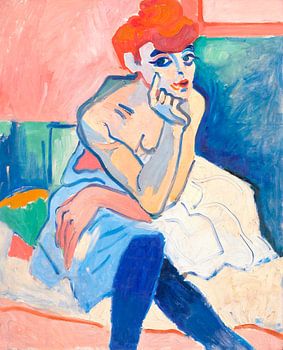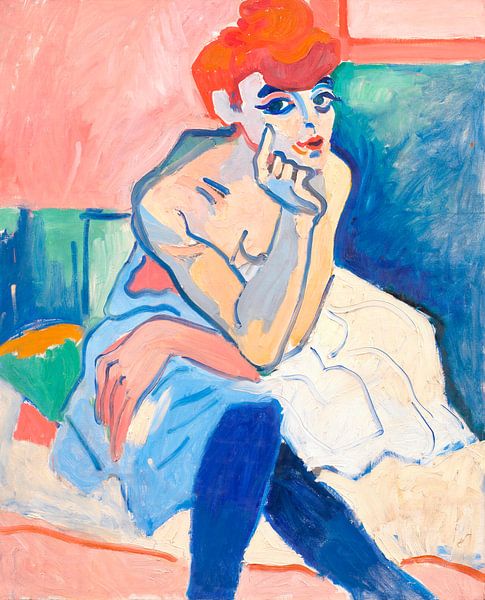

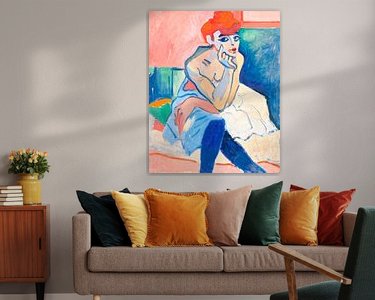

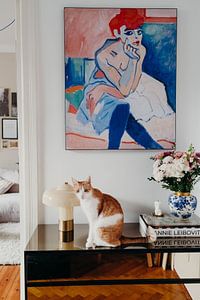


Woman in a Chemise, André Derain
The manner of painting is not the only interesting feature of this picture. André Derain draws on an established tradition in modern French art: finding artistic subject matter in places of entertainment in Paris. The generation of artists that preceded him, such as Toulouse-Lautrec, moved among dancers and performers in the late 1800s, and André Derain reinterprets such imagery by means of modern devices.
His painting shows a dancer from the restaurant and night club Le rat mort (The Dead Rat), which was also one of Toulouse-Lautrec’s regular haunts. Half undressed, the dancer sits with her stockinged legs crossed, slumped on what looks like a bed as she looks directly out at us.
‘It’s a tremendously strong image. The composition has been very carefully thought through, based on a triangular system, and the overall effect gives the painting a strong monumentality. The stringency of the composition and the simple colour scheme with its vivid contrasts helps create a visual impact that is almost poster-like,’ says Dorthe Aagesen.
The painting is a key work from Derain’s ‘Fauvist’ period (from the French, Le fauve: the wild ones). It has its origins in a summer spent with the somewhat older fellow artist Henri Matisse in 1905 in the town of Collioure in the south of France. Here, they both experimented with using colours in new ways, taking them beyond a purely descriptive function, such as showing us that the sea is blue. Here, colours