





Art code
Art code copied
You can't see it in full detail right now, but you certainly will on your wall soon!
Scroll to zoom in, drag to move the artwork.
Drag with your finger to move the artwork.
Already filled more than 375,000 walls!
Get even more inspired
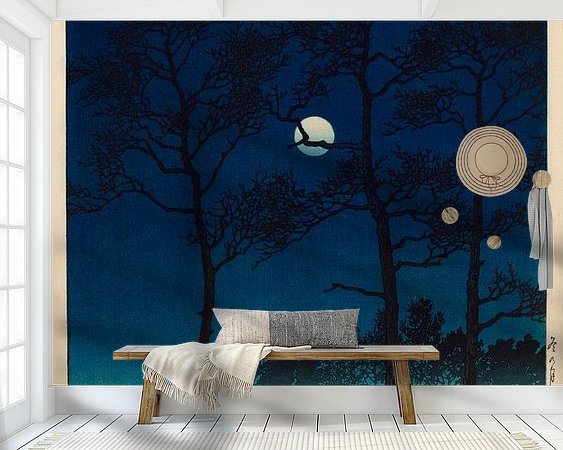
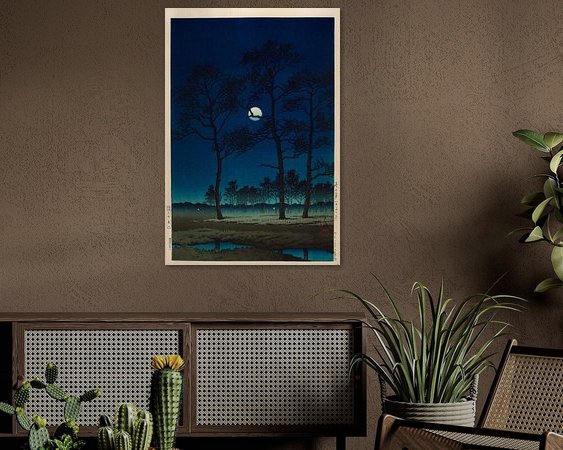
About ‘Winter Moon over Toyama Plain, Kawase Hasui’
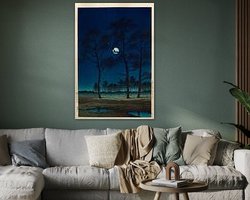
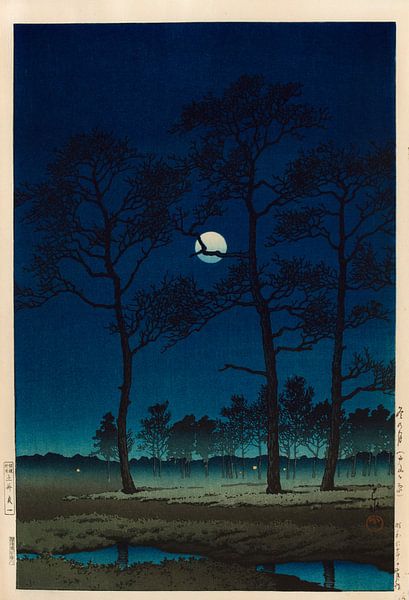
Winter Moon over Toyama Plain (1931), Kawase Hasui
Hasui Kawase was a Japanese artist who was one of 20th century Japan's most important and prolific printmakers. He was a prominent designer of the shin-hanga ("new prints") movement, whose artists depicted traditional subjects with a style influenced by yōga (Western-style painting). Like many earlier ukiyo-e prints, Hasui's works were commonly landscapes, but displayed atmospheric effects and natural lighting.
Hasui designed almost one thousand woodblock prints over a career that spanned nearly forty years. Towards the end of his life the government recognized him as a Living National Treasure for his contribution to Japanese culture.
Hasui was born in 1883. As a youth, he dreamed of an art career. His paternal uncle was Kanagaki Robun (1829–94), a Japanese author and journalist, who produced the first manga magazine. Hasui went to the school of the painter Aoyagi Bokusen as a young man. He sketched from nature, copied the masters' woodblock prints, and studied brush painting with Araki Kanyu. His parents had him take on the family rope and thread wholesaling business, but its bankruptcy when he was 26 led him to pursue art.
He approached Kiyokata Kaburagi to teach him nihonga (Japanese style painting), but Kaburagi instead encouraged him to study yōga (Western-style painting), which he did with Okada Saburōsuke for two years. Two years later he again applied as a student to Kaburagi, who this time accepted him. Kiyokata bestowed the name Hasui upon him, which can be translated as "water gushing from a spring", and derives from his elementary school combined with an ideogram of his family name.
After seeing an exhibition of Shinsui Itō's Eight Views of Lake Biwa, Hasui approached Shinsui's publisher Shōzaburō Watanabe, who had him design three experimental prints that Watanabe published in August 1918. The series Twelve Scenes of Tokyo, Eight Views of the Southeast, and the first Souvenirs of Travel of 16 prints followed in 1919, each issued two prints at a time.
Hasui's twelve-print A Collection of Scenes of Japan begun in 1922 went unfinished when the 1923 Great Kantō earthquake destroyed Watanabe's workshop, including the finished woodblocks for the yet-undistributed prints and Hasui's sketchbooks. He lost 188 sketchbooks in which he had drawn landscapes and other subjects.
He travelled the Hokuriku, San'in, and San'yō regions later in 1923 and upon his return in February 1924 developed his sketches into his third Souvenirs of Travel series. His sketching trip at this time lasted 102 days, the longest trip of his life. Many of the sketches he made on this trip became the basis for many of his later works. After this trip, the vividness of his colors and the realism of his work increased, and he gained further fame.
From the series Twenty Views of Tōkyō, Zōjō-ji Temple in Shiba, published in 1925, became Hasui's best-selling work and many printmakers began to imitate his style.
Hasui built a new house in Magome in 1930, and Moon at Magome from the series Twenty Views of Tōkyō sold that year became his second best-selling work.
Hasui studied ukiyo-e and Japanese style painting at the studio of Kiyokata Kaburagi. He mainly concentrated on making watercolors of actors, everyday life and landscapes, many of them published as illustrations in books and magazines in the last few years of the Meiji period and early Taishō period.
During the forty years of his artistic career, Hasui worked closely with Shōzaburō Watanabe, publisher and advocate of the shin-hanga movement. His works became widely known in the West through American connoisseur Robert O. Muller (1911–2003). Landscape prints were the most popular of the shin-hanga, and their reputation in the United States reached its peak in the mid-1930s, when Hasui was considered the leading landscape printmaker.
In 1956, he was named a Japanese Living National Treasure. The government Committee for the Preservation of Intangible Cultural Treasures had intended to honor traditional printmaking via awards to Hasui and Ito Shinsui in 1953. Because the artists' work necessitated collaboration between designer, engraver, and printer, objections were raised over singling out individual participants for recognition. Therefore, they commissioned the artists to make new prints, the production of which was carefully documented. Hasui's biographer, Narazaki Munishige, was one of those who recorded the process. Thus, Snow at Zōjō-ji was completed in 1953, and the process of printing 42 times was recorded for posterity.
Hasui died on November 27, 1957. He had created around 620 prints over the course of his career. In 1979 Narazaki published a biography and compiled the first catalogue raisonné. An exhibition of 180 of his prints was held in Tokyo in 1982. The catalogue was entitled: "Hasui Hasui: The End of the Line For Ukiyo-e".
Colors
Discover our ArtFrame
The modern canvas alternative
Your chosen art on a textile print, stretched in an aluminum or wooden frame. Quick and easy to change for a fresh look and exactly as you want it.
- High-quality print
- Easily replaceable
- Acoustic function
- Large formats possible
Discover the Old Masters collection



Customer reviews
4.8/5

Related collections