




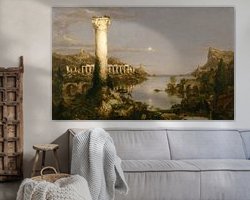

About ‘Desolation, Thomas Cole’
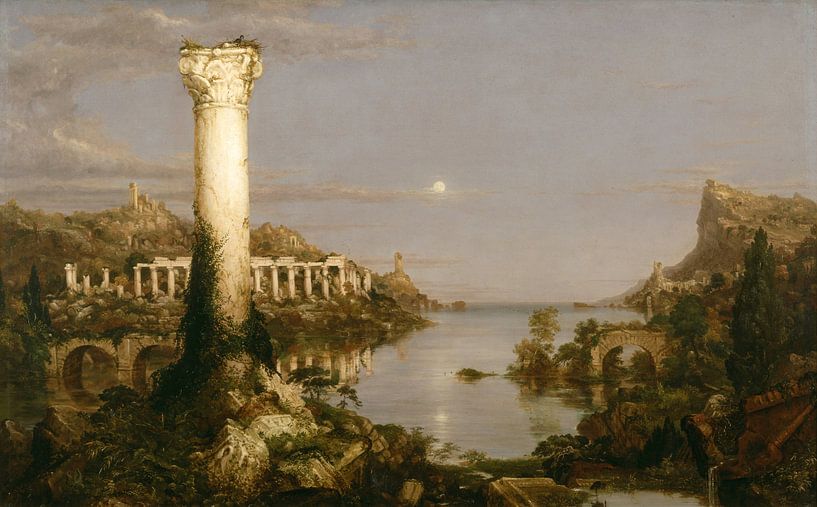
Desolation, Thomas Cole.
Part of the series "The Course of Empire".
The fifth painting, Desolation, shows the results, decades later. We view the remains of the city in the livid light of a dying day. The landscape has begun to return to wilderness, and no humans are to be seen; but the remnants of their architecture emerge from beneath a mantle of trees, ivy, and other overgrowth. The broken stumps of the pharoses loom in the background. The arches of the shattered bridge, and the columns of the temple are still visible; a single column looms in the foreground, now a nesting place for birds. The sunrise of the first painting is mirrored here by a moonrise, a pale light reflecting in the ruin-choked river while the standing pillar reflects the last rays of sunset. This gloomy picture suggests how all empires could be after their fall. It is a harsh possible future in which humanity has been destroyed by its own hand.
This cycle reflects Cole's pessimism, and is often seen as a commentary on Andrew Jackson and the Democratic Party. (Note, for instance, the military hero at the centre of "Consummation.") However, some Democrats had a different theory of the course of empire. They saw not a spiral or cycle but a continuing upward trajectory. Levi Woodbury, a Democrat and a justice of the United States Supreme Court, for instance, responded to Cole by saying that there would be no destruction in the United States.
Colors
Discover our Canvas
Classic and timeless material
Art on canvas looks great on any wall. It truly comes into its own with paintings featuring sharp brushstrokes.
- Fine-art quality
- Frame made from sustainable wood
- Durability of at least 10 years
- Available with shadow gap frame

Discover the Old Masters collection






Customer reviews
4.8/5

Related collections